What a time to be alive, huh?
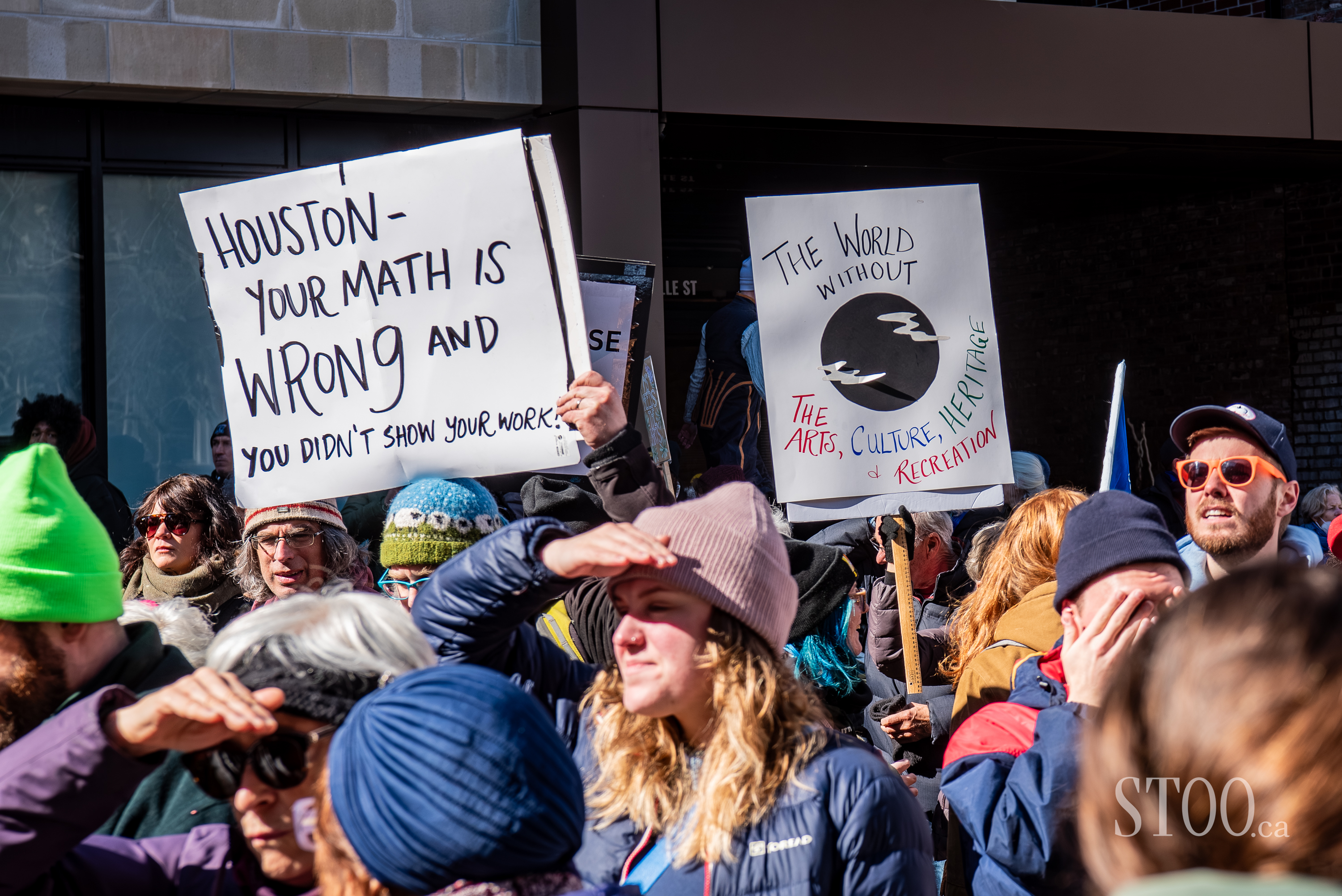
For the last two weeks, artists and cultural workers in Nova Scotia have been resisting proposed cuts to Communities, Culture, Tourism, and Heritage outlined in the 2026-27 provincial budget. There have been rallies of several thousand people at Province House over the last two weeks. Yesterday, the Premier even walked back some of the proposed cuts, though he allowed the cuts to arts and culture to stand.
And of course, lots of folks have lots to say about it all. Yesterday, on my old program, Mainstreet on CBC Radio One, the Spinbusters panel spoke about the walkback of some cuts, but not others. You can listen to that here.
I listened to it yesterday, and I’ll be responding to it today on Mainstreet.
Meanwhile, here’s an email I sent to the show in response:
Hi Mainstreet,
I always enjoy the opportunity to hear the Spinbusters panel. Michelle, Barb, and Chris bring so much to the party and I appreciate the opportunity to consider politics in Nova Scotia from their varied points of view.
However, as a former child actor, Chris Lydon may be a lot of things, but knowledgeable on Nova Scotia’s arts and culture sector is not among them—with all respect to Chris.
Chris said that cutting funding to the arts is okay, because we’ll just sell more tickets, sell more pieces of art, or sell more albums, and make more money. This indicates a serious misunderstanding of what’s at stake with these proposed cuts—along with an ignorance, perhaps, of the work most of us in the sector are actually doing. (Plus, if Chris has some special understanding about how to “just sell more” tickets, art, or albums, I know several thousand Nova Scotian artists who would love to hear his secret!)
I want to talk specifically about two programs that this proposed budget cuts down to zero. Absolutely to zero: disappeared, not happening anymore.
They are Artists in the Schools, and Artists in Communities. Two places we should all want artists, btw. And perhaps the names of these programs are a clue to the lack of a path to revenue for projects that used to be supported by these funds.
Artists in the Schools was an envelope of money that supported programs like WITS—Writers in the Schools, PAINTS—Professional Artists in the Schools, and PERFORM—A program that brought professional dancers, theatre and choral artists into schools. If your kid goes to school in Nova Scotia, they benefited from these programs. They had the opportunity to meet and learn from professional artists in their classrooms, from K to grade 12. An incredible opportunity to access art and to engage with making art, for free, as part of their school day.
No path to revenue, there. Amazing value for the money—engagement with arts and culture has been proven time and again in study after study to be protective of physical and mental health and wellbeing, to improve educational outcomes for students, and to promote and protect social cohesion. Without this engagement with art and culture, these costs will fall on the government.
Artists in Communities was a program that supported community based and socially engaged art practices. It provided funding to strengthen relationships between artists and non-artist communities. One example of how funding from that envelope was used: the organization I co-founded received funding to run our Youth Mentorship Program, which paired young writers of high school age with professional writers for a six-week virtual mentorship. Those young writers received guidance and feedback on their writing, advice about presenting their work publicly, an example of what life as a professional artist could look like—and ultimately a friend, ally, and valuable connection in the field if the young writer were to choose to pursue writing as a career. Plus, those young writers got their first paid professional gig, reading their work at an AfterWords festival event.
No path to revenue there. No way to replace that programming, or the many other projects, small and large all around the province, woven into various communities, providing Nova Scotians from all walks of life with a sense of self, an outlet for expression, a way of belonging.
These are just two examples of programs that were cut to zero in this proposed budget. Programs that are not about making money (you know, the same way police, fire, and ambulance services are not about making money. The same way roads are not about making money. The same way even paper mills in Nova Scotia don’t necessarily have to make money in order to get government support). These are programs that employed Nova Scotians. These are programs that served Nova Scotians. These are programs that met Nova Scotians in their communities and helped them access that ingenuity and creativity that Barb spoke so eloquently about.
Even if we could convince ourselves that Artists in the Schools and Artists in Communities are frills, nice to haves, programs for the “when we can do more, we do more” basket, the notion Chris floated that artists and arts organizations can just do more capitalism in order to continue to make art just doesn’t actually bear up to even the mildest scrutiny.
Let’s take my organization as an example. In order to derive most of our revenue from ticket sales we would need—in a jurisdiction like Nova Scotia with just a million people in the whole province as potential audience—to sell tickets at such a high price that pretty much no one could attend our festival events. That’s not because we are terrible at our jobs (jobs, by the way, that we created, and that we do for just under a living wage, and on which we pay taxes, and with which we pay our mortgages, buy groceries and gas, shop at local businesses etc). Our operating budget and the project grants we are able to access pay our artists (about half of them are Nova Scotian, the other half get paid while they are in Nova Scotia and spend some of that money here), pay for hotel nights, and cabs, and meals, and venues, and photographers, and a publicist, and a graphic designer, and our local printer, our local t-shirt printer, to buy some ads in local media, to pay our web designer, our social media contractor, and all the other myriad expenses that are incurred by your average arts festival.
You’ve heard the federal study that revealed that a dollar of government investment in the arts returns 29 dollars. We spend that money that we get in our local communities, and we spend it fast. We are nonprofits and registered charities—we’re not allowed to hoard wealth. We do not have shareholders who expect a return. You give us a dollar and we hand it over to your neighbour who writes our press releases, or designs or prints our posters, or who takes photographs at our events, or provides catering, or works at one of our venues.
And by the way, we are not solely reliant on government investment. We attract sponsors and donors large and small. We seek support from private foundations. We derive some revenue from ticket sales and tshirt sales. We are doing the work we need to do in order to diversify our revenue streams so that we are sustainable and on solid footing. And the government’s investment in the arts accounts for .08% of the entire provincial budget. A vanishingly small amount.
But we are contributing—economically and socially—to the vibrancy and health of this place. And every government traffics in what we bring. Every government touts our incredible culture, our vibrant arts. People are not coming to visit Nova Scotia because our HST is 14% or because our city bridges are now toll-free. They are coming for Rebecca Thomas and Rachel Reid. For Nocturne and Alan Syliboy. For Aquakultre and Jordan Bennett and Maud Lewis and Anne Murray and Joel Plaskett and the Jazz Festival and Shakespeare by the Sea and the Cabot Trail Writers Festival.
Supporting the arts is not just buying tickets to shows, or buying paintings, or albums—though all of that is wonderful, and meaningful to individual artists. Supporting the arts is understanding the thousands of ways the work of artists and cultural workers is woven into the fabric of this place. The serious work we are doing in every community, work that Nova Scotians are the poorer without. And by the way, those artists I mentioned above, they don’t spring up out of nothing. They don’t just happen out of thin air or dry ground. Each of those artists and festivals arises in an ecosystem, such as we have had in Nova Scotia for several generations, and such as will be actually literally devastated should these proposed budget cuts become enacted.
The Premier said, in Pictou County the other night, that families are better spenders of their money than government. That with more money in their pockets, families can invest in what they want to, including the arts. But families can’t bring back Artists in the Schools. Families can’t bring back Artists in Communities. Families can’t keep the lights on at the local theatre or live music venue. They can’t keep galleries open. They can’t help theatre artists develop their new play, they can’t support a writer while they write their next book—which could become the next Heated Rivalry, or the next Fall on Your Knees or The Berry Pickers. The same way they can’t pay paramedics or pave roads. This is literally what government is for. If our government cannot see that, and cannot understand that this kind of cut to arts and culture is cutting off its nose to spite its face, perhaps it should not be our government right now.
Thanks for reading,
Stephanie Domet
author of Homing and Fallsy Downsies, co-author of Amazing Atlantic Canadian Women, co-founder and co-executive director of AfterWords Literary Festival
photo of the March 4 Culture is Critical Rally taken by the always amazing Stoo Metz.
 Stephanie Domet
6 responses to “Don’t go breaking our arts or, Why a capitalist argument doesn’t work for the ecosystem of arts and culture in Nova Scotia”
Very well put Steph. I’ve become of the opinion that the people making decisions in this government may very well have university training. But none of them are educated. I’m an engineer. Someone who should be first in line in not understanding the value that the arts and culture sector bring to our society. But one need only look to history to see that our social constructs do not survive without a strong cultural sector. And indeed it is the cultural remnants of civilizations that survive the ravages of time, while the works of my “professional ancestors” stand, or lie, for the most part as ruins.
Thanks Jeff. It’s the willful ignorance that gets me every time. Educated or not, anyone can learn to think critically, ask questions, consider nuance, and not be a knob!
you’ve coined the rallying cry!
DEAR TIMMY!
DON’T BE A KNOB!!
Thanks! Economy always starts with people. How insane it is to think any economic strategy can work without including strategic investments in nurturing people and healthy socially integrated communities? (all of that requires investing in maintaining all kinds of Artists and access to healthy biodiverse green spaces and heritage sites) Bill 198 looks like a hack job performed by a sociopath and a financial idiot.
Stephanie; I heard you on CBC Mainstreet (miss you from when it was your job and back on DNTO) and appreciated your points very much. I
‘m usually a fan of the Spin Busters, but this last episode surprised me! Two weeks earlier, they were their usual incisive selves, maybe with a little partisanship showing, but only just. But this week? Wow. They drank Houston’s Koolaid, how brave he was to be repentant blah blah. And the child actor, well…
Michele Coffin sound like she truly understood the bs penitent act of the premier.
When I wrote to my MLA, she responded that she had worked at a museum as a student so that gave her a lifelong appreciation of the arts, which made her work re supporting this budget so hard, but she’d do it, and putting money back later would be a priority.
Who do they think we are, out here in the boonies? Perhaps the level of discourse on Facebook gives them a jaundiced opinion of the voters, but not right now, baby.
Anyway, you know all this. I was thrilled to hear you deliver a great rebuttal to the Spinbusters. Keep it up!
Excellent read. Thank you for helping me understand why this is a big deal. I hope Mr. Houston comes to his senses, but I fear he’s too busy woo-ing mining companies for whom he is happy to bend environmental regulations. It’s so frustrating. Hang in there!